Electrostatic MEMS Accelerometer: Coupled FEM and Reduced-Order Model
IC and MEMS Design, BME · Budapest, Hungary · Autumn 2025 · Academic project · Individual
Coupled electrostatic-structural simulation of a MEMS accelerometer in ANSYS with hand-calculation checks at every step, exported as a reduced-order model and exercised in Twin Builder.
- ANSYS
- Twin Builder
- FEM
- Reduced-order model
- MEMS
Overview
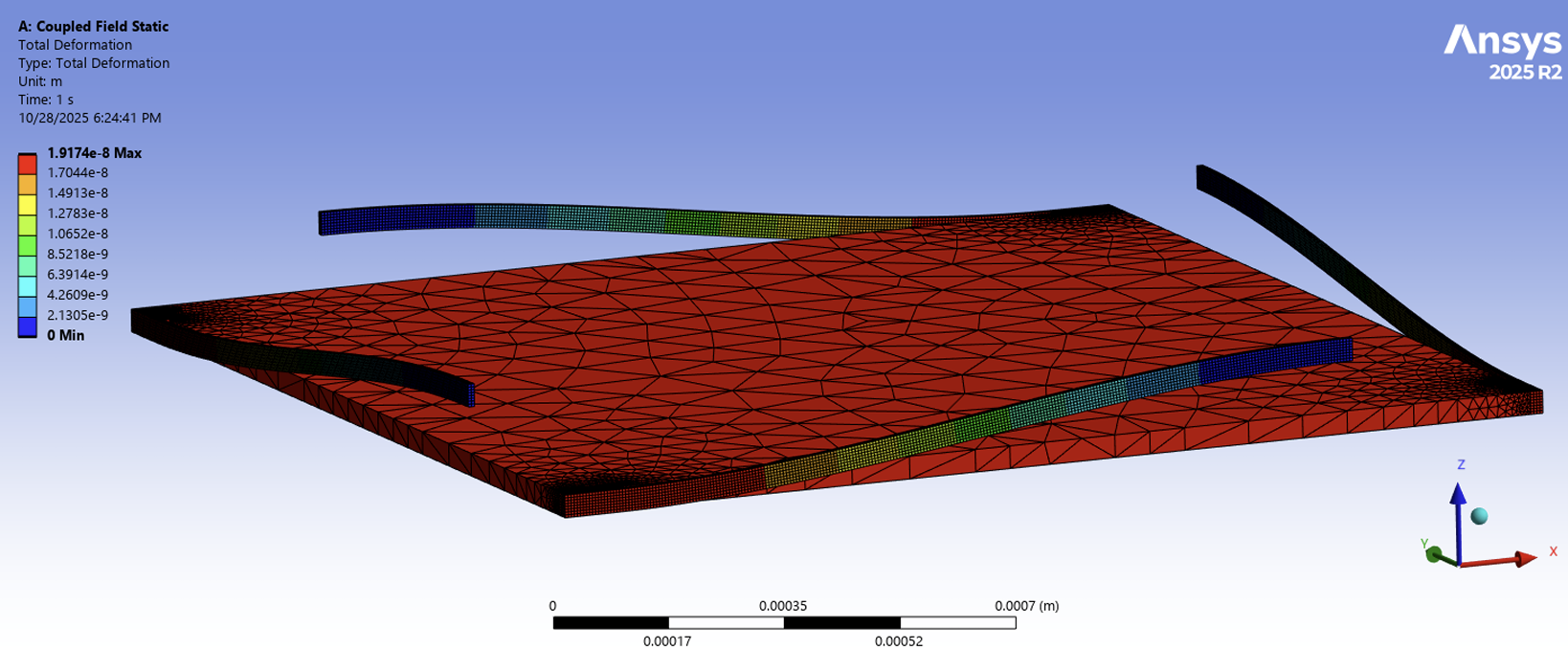
A silicon proof mass suspended on four beams over a 2 um air gap, simulated with full electrostatic-structural coupling: deflection under bias, spring softening, capacitance, and prestressed modal analysis, then reduced to a compact model for system-level simulation.
Technical approach
- Coupled-field static analysis at 1 V and 3 V bias on a mesh of about 45,500 nodes
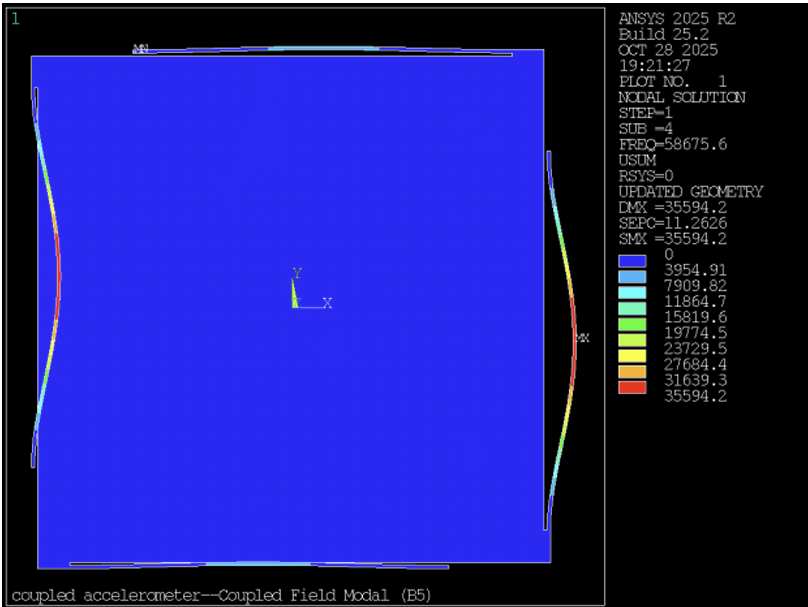
- Electrostatic spring-softening and linear-perturbation modal analysis
- Capacitance extracted from field energy
- Reduced-order model export and a transient 1 g acceleration simulation in Ansys Twin Builder
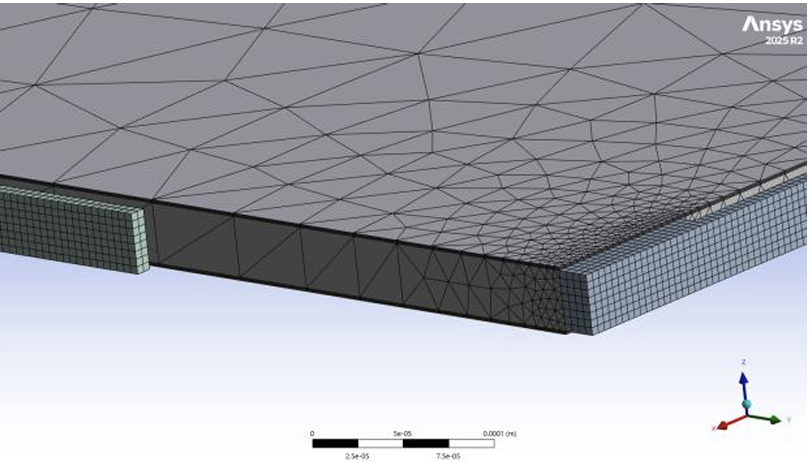
- Mesh designed with refinement at the suspension beams and plate edges where gradients concentrate
- Analytical hand calculations (stiffness, pull-in, capacitance, natural frequency) as an independent check on every simulated quantity
- Complementary ANSYS APDL exercises (coupled-field scripting) completed in the same course
Results
- Simulated results matched analytical estimates within 10 percent across all compared quantities (several within 1 to 3 percent)
- First natural frequency of 4269 Hz versus 4342 Hz analytical; ROM ring-down at 3731 Hz versus the biased modal result within 0.4 percent
Media