Shutterless Calibration of a Thermal Camera and Its Real-Time Streaming Platform
IDEAS (Integrated Detector Electronics AS) with USN · Oslo, Norway · Jan to June 2026 · Academic project · Individual thesis
M.Sc. thesis at IDEAS (Integrated Detector Electronics AS): radiometric characterization of an uncooled LWIR microbolometer camera and development of shutterless drift-compensation methods, together with the FastAPI and React platform used to stream, record, and calibrate it in real time.
- Thermal imaging
- Calibration
- Python
- FastAPI
- React
- Signal processing
Overview
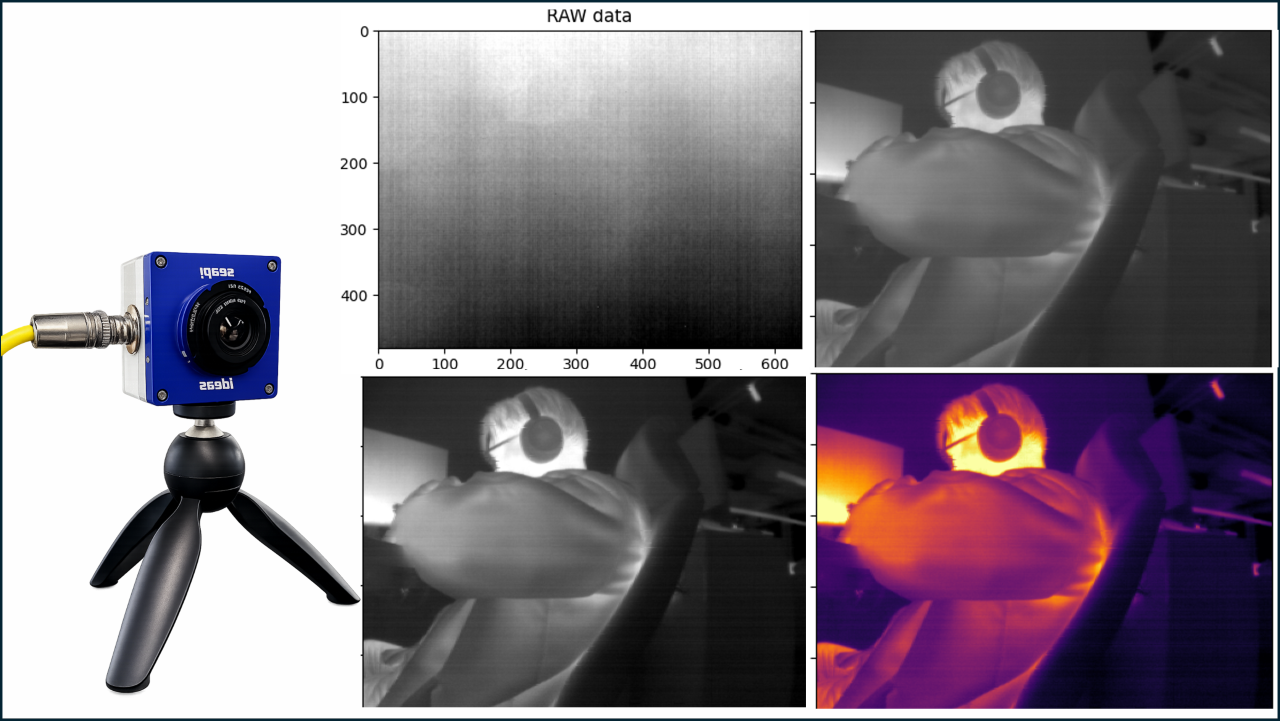
Uncooled thermal cameras drift as their own electronics warm up, and most compensate with a mechanical shutter that briefly blinds the camera. This thesis characterized an uncooled LWIR microbolometer camera (640x480, 12 um pitch, 8 to 14 um band) and developed shutterless calibration alternatives, so the camera stays uninterrupted while staying radiometrically usable. The second half of the work was the platform around the camera: a real-time acquisition and streaming backend plus a web client, used for every measurement and demonstration in the thesis.
Technical approach
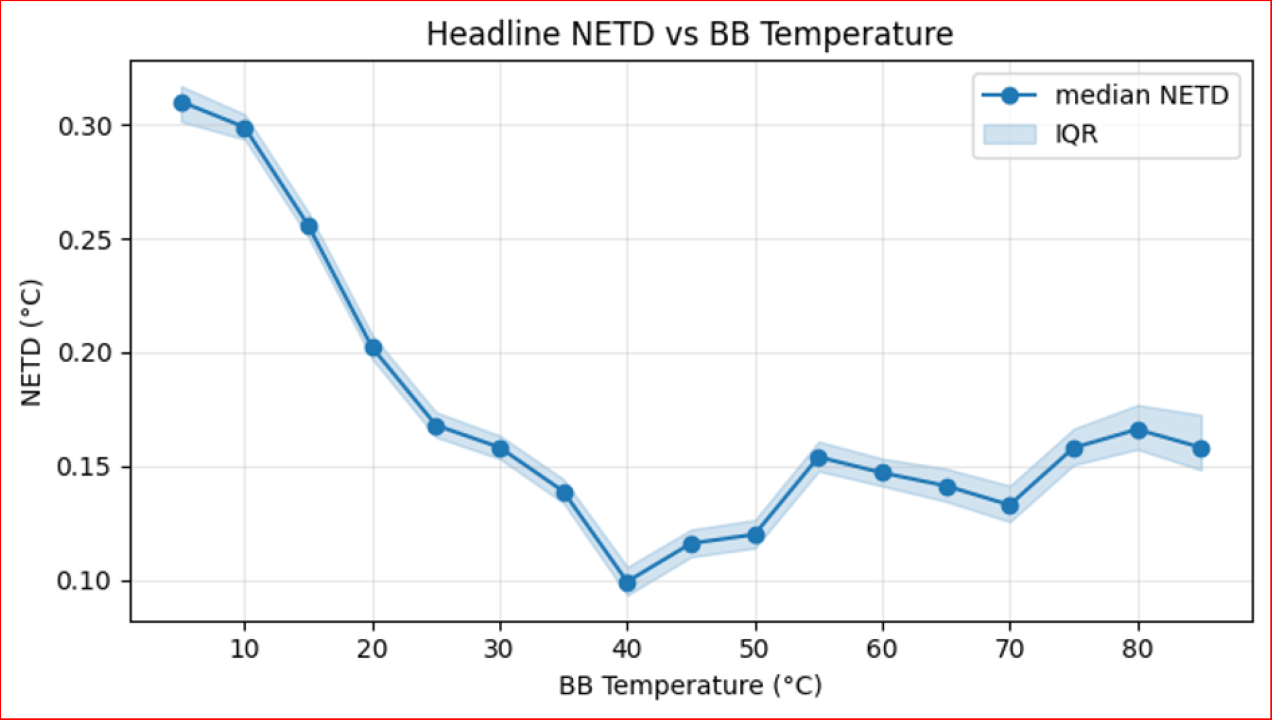
- Characterized the camera against a calibrated blackbody source over a 0 to 110 C sweep in 5 C steps, deriving per-pixel signal transfer function, responsivity, and NETD
- Recorded cold-start warm-up sequences after thermal-chamber conditioning to quantify fixed-pattern noise and thermal drift
- Implemented and compared shutterless non-uniformity correction methods: one-point and two-point correction, a lookup-table library of 95 calibration matrices, temperature-indexed calibration with linear interpolation, and scene-based correction
- Defined image-quality metrics (high-pass roughness, column fixed-pattern noise, spatial sigma) so the platform can select the best correction matrix automatically during live operation
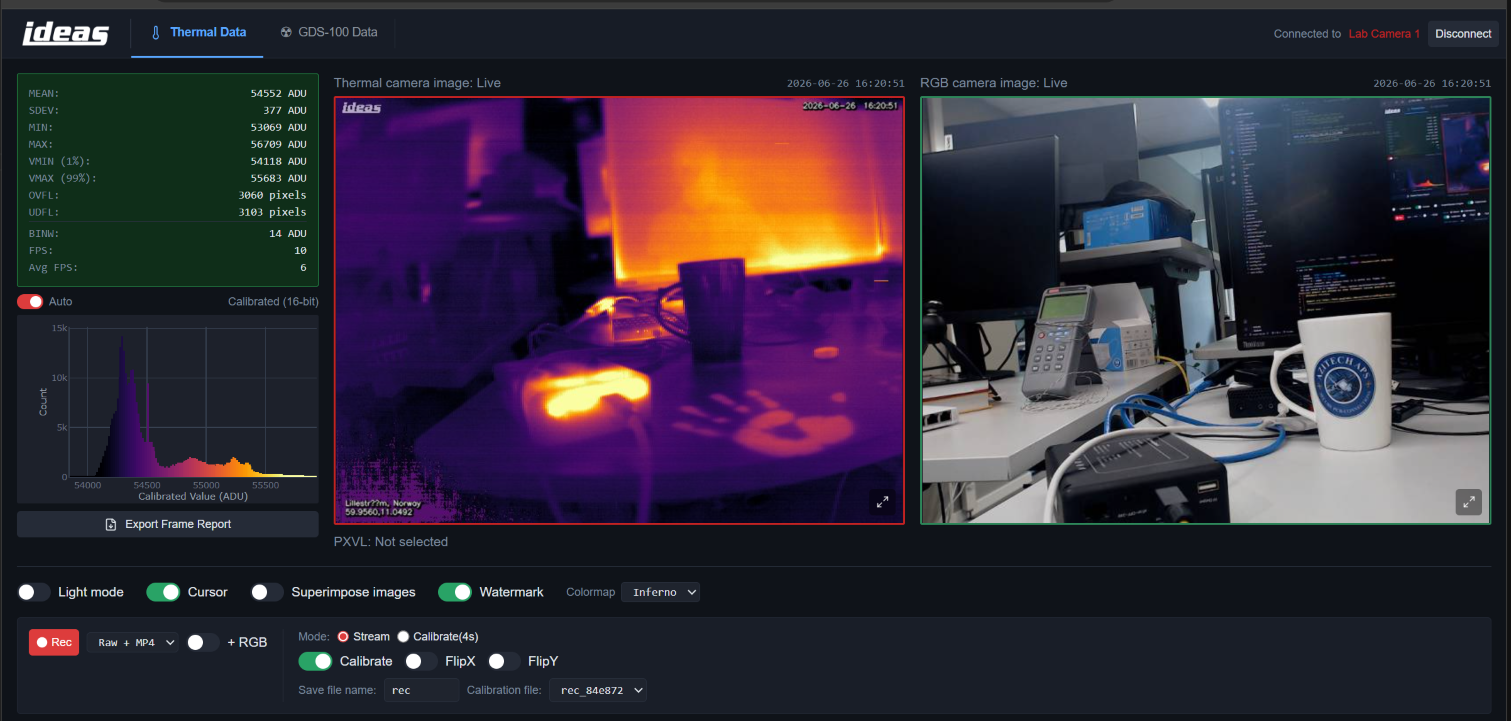
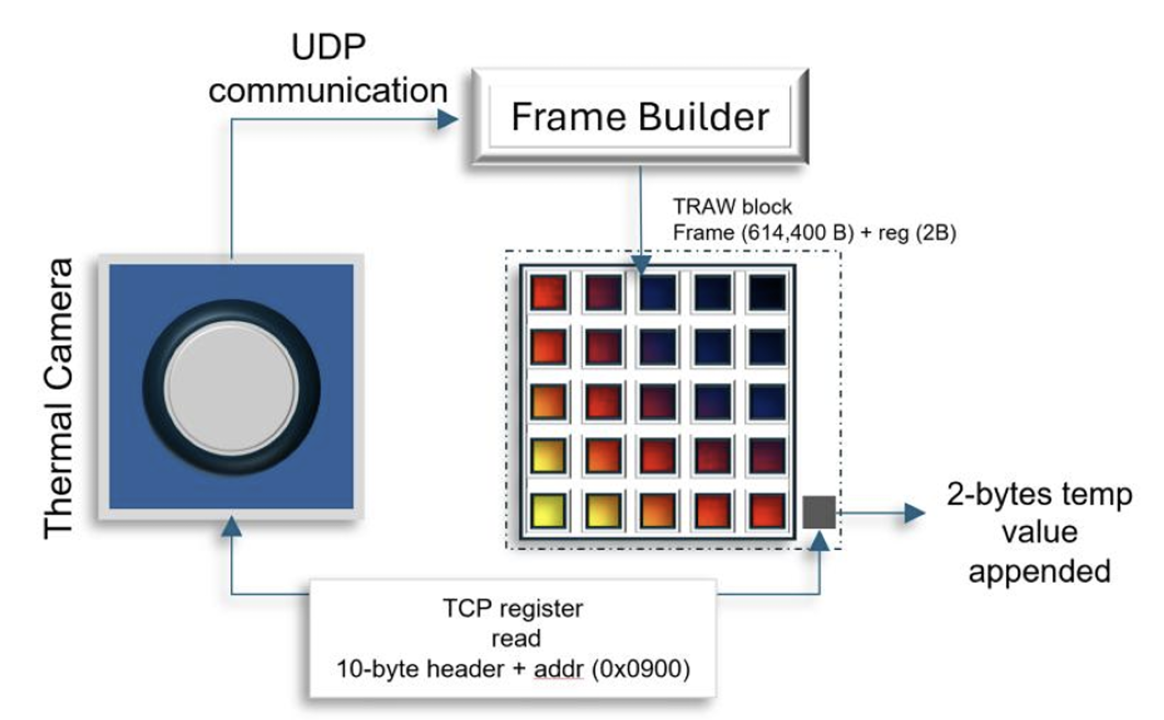
- Built the streaming pipeline (RTP over UDP ingestion of 16-bit frames at about 10 fps, TCP and WebSocket forwarders for remote camera nodes) and a FastAPI backend with per-client sessions, recording, and calibration control
- Built a React and TypeScript web client with live visualization, camera control, statistics and histograms, and PDF reporting
Results
- Minimum median NETD of 99.3 mK near a 40 C blackbody setpoint (interquartile range 93.5 to 105.8 mK)
- Showed that warm-up drift is offset-dominated: pixel gain stays nearly stable after the initial transient, which is what makes offset-only shutterless correction viable
- In a 10-minute stability comparison the lookup-table correction kept spatial noise roughly constant while one-point and two-point corrections degraded several-fold
- Scene-based correction showed to be a better approach when the scene has enough motion.
Constraints and lessons
Temperature-indexed correction using a single board-temperature proxy performed worst: the same proxy temperature can correspond to different detector states, so drift compensation needs image-derived quality metrics rather than temperature alone. Scene-based correction works well with motion but introduces ghosting on static scenes.
Media
Resources
Also listed under: Software & Machine Learning